How the Human Eye Works
85% of EVERYTHING WE LEARN IS THROUGH THE EYE. Generally we learn 85% through sight, 10% through hearing, 3% from smell, 1% by touch and 1% through taste.
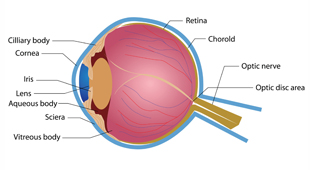
The eye is a complex sensory organ specialized for the gathering of visual information. The eye gives us the sense of sight, allowing us to learn more about the world than do any of our other five senses. Ninety-five percent of everything we learn is through our eyes. The eye allows us to see and interpret the shapes, colors and dimensions of objects in the world by processing the light they reflect. The eye can see in dim light or bright light, but it cannot see an object when light is absent. The light rays are changed into electrical signals by the eye and they are then sent to the brain, where these electrical signals as interpreted as visual images.
The human eye can be compared to a camera that gathers, focuses, and transmits light through a lens to create an image of the environment. In a camera, the image is created on film; in the eye, the image is created on the retina, a thin layer of light sensitive cells at the back of the eye. The lens of the eye bends, or refracts, light that enters the eye.
LEARN MORE
Anatomy of the Eye
Glossary of Eye Terms
Eye Care Professionals
Twenty Years of Hope and Sight for Armenian Eyes.More Videos
![]()